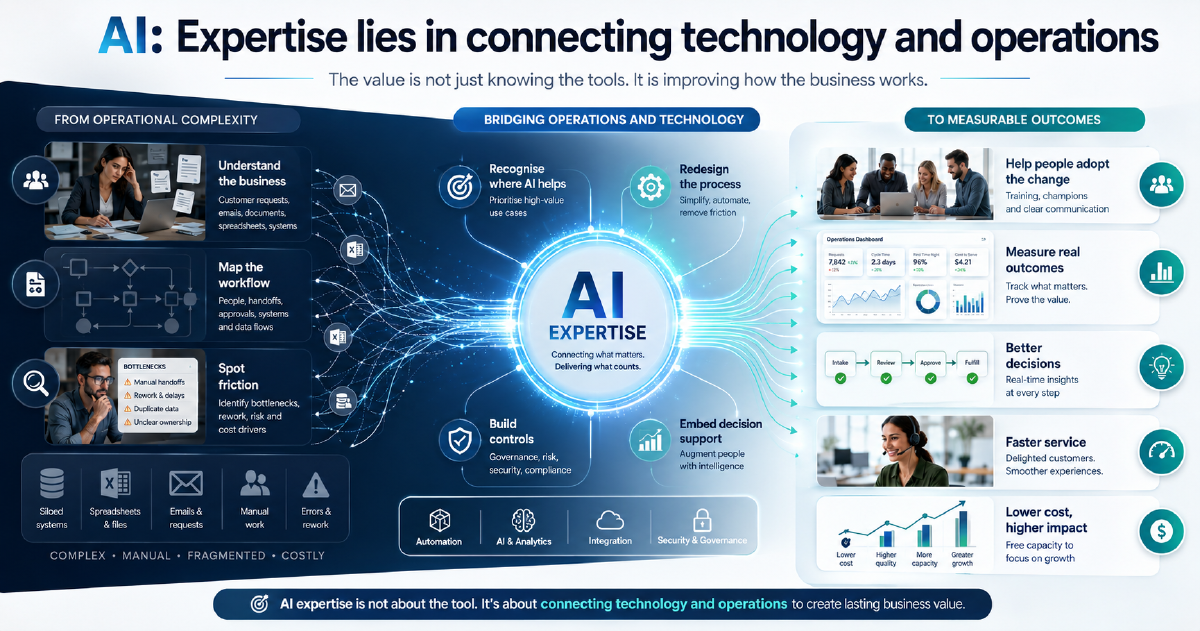
The value of an AI specialist is not simply knowing which tools or models are available. It is understanding how work happens inside a business and knowing how technology, process and people must change together to produce a worthwhile result.
Understand how the business currently operates #
A wholesaler believes its customer service team is overwhelmed because employees spend too long writing emails.
A review of the real workflow shows that writing the response is only a small part of the problem. Employees must search three systems for order information, check stock with the warehouse, ask finance whether an account is on hold and confirm delivery dates with a separate logistics provider.
An AI email-writing tool would save a few minutes. Mapping the operation reveals that the real delay is gathering reliable information.
The first step is therefore not selecting an AI product. It is understanding where time, effort and uncertainty currently enter the process.
Recognise where AI can genuinely help #
A manufacturer wants to use AI to automate quality inspections.
Closer analysis shows that its product images are inconsistent, defect labels are unreliable and many faults can only be identified through physical testing. Fully automated inspection would be risky and expensive.
However, engineers spend several hours each day reviewing maintenance logs and identifying recurring equipment problems. Those records are detailed and contain repeatable patterns.
Instead of forcing AI into the inspection process, the company uses it to summarise maintenance histories, group similar faults and highlight equipment that may require preventative work.
The best opportunity is often not the most visible or ambitious use of AI. It is the point where suitable information, repetitive effort and clear business value already overlap.
Redesign the surrounding process #
A property management company introduces AI to classify tenant maintenance requests.
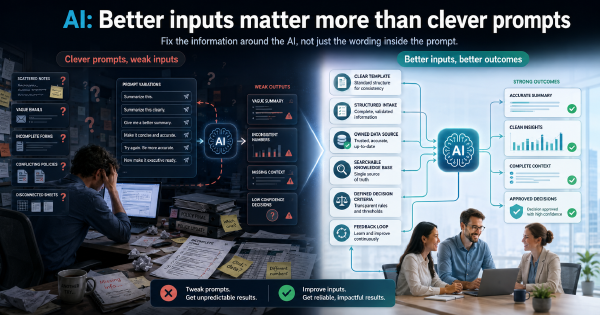
Originally, the plan is for AI to read each email and assign it to plumbing, electrical or general maintenance. This saves a dispatcher a small amount of time, but contractors still contact tenants repeatedly because important information is missing.
The process is redesigned so that tenants are asked structured questions when submitting a request:
- Where is the problem?
- When did it start?
- Is water, electricity or heating affected?
- Is there an immediate safety risk?
- Can photographs be provided?
- When can a contractor access the property?
The AI then classifies urgency, identifies the appropriate contractor and prepares a complete work order.
The value comes not from automating one existing step, but from changing the input and routing process around it.
Implement appropriate controls #
A recruitment company uses AI to summarise CVs and compare applicants against role requirements.
Without controls, recruiters might rely on an unexplained score or allow irrelevant personal information to influence recommendations.
The workflow is designed so that:
- AI evaluates only agreed job-related criteria.
- Sensitive personal information is excluded.
- Every recommendation includes supporting evidence from the application.
- The system cannot automatically reject a candidate.
- Recruiters record the final decision and their reasoning.
- Results are monitored for unexplained differences between candidate groups.
The control is not a lengthy approval process added after the AI has acted. It is built into the way information is selected, recommendations are presented and decisions are made.
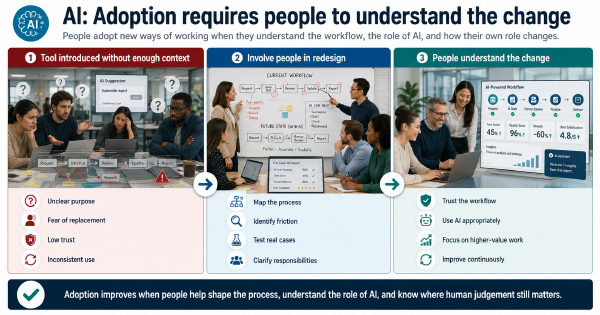
Help employees adopt the new way of working #
A finance team introduces AI to review staff expenses and identify missing receipts, unusual claims and possible tax issues.
Employees initially resist the system because they believe it is designed to monitor their performance or remove jobs. Some reviewers ignore the recommendations, while others approve them without checking.
The implementation team works with expense reviewers to clarify the new division of responsibilities:
- AI performs the first-pass checks.
- Employees investigate unusual or ambiguous claims.
- Reviewers remain responsible for the final decision.
- Incorrect recommendations can be flagged directly.
- Common issues are reviewed with the team each month.
- Training uses real historical claims rather than generic demonstrations.
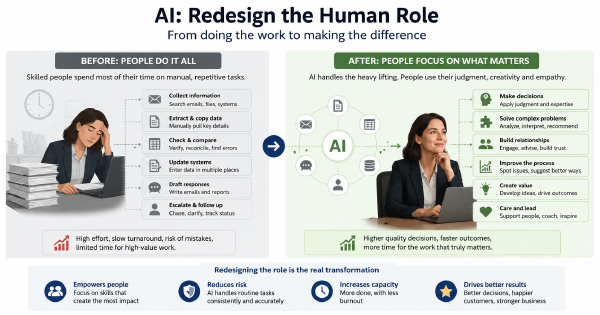
Employees begin to see that the system removes repetitive checking while giving them more time to investigate genuinely risky cases.
Adoption comes from helping people understand how their role is changing, not simply teaching them which buttons to press.
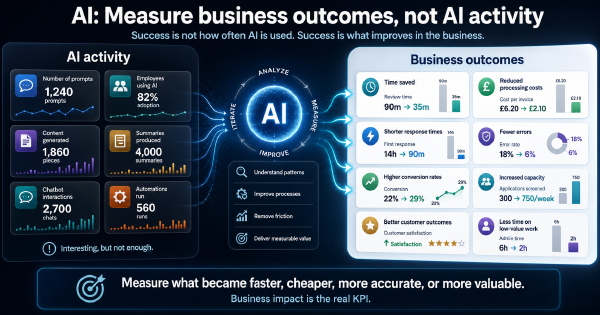
Measure whether the change produced a real gain #
A sales team introduces an AI assistant that prepares account summaries before customer meetings.
The company could report that 80% of salespeople use the tool or that it generated 4,000 summaries. Neither measure demonstrates business value.
Instead, it compares outcomes before and after the change:
- Preparation time falls from 45 minutes to 15 minutes per meeting.
- Salespeople hold 18% more customer conversations.
- Follow-up actions are sent within one day rather than three.
- Fewer meetings are missed because account risks were overlooked.
- Conversion from demonstration to proposal increases from 31% to 36%.
The team also checks whether the summaries are accurate and whether salespeople find them useful. If usage is high but conversion and preparation time do not improve, the initiative has not succeeded.
The real expertise lies in connecting all six elements.
Understand the work, find the point of leverage, redesign the process, control the risks, bring employees with you and prove that the business is better afterwards.
The biggest AI gains rarely come from dropping a new tool into an old process. They come from making a few intelligent changes to how information flows, decisions are made and people spend their time.