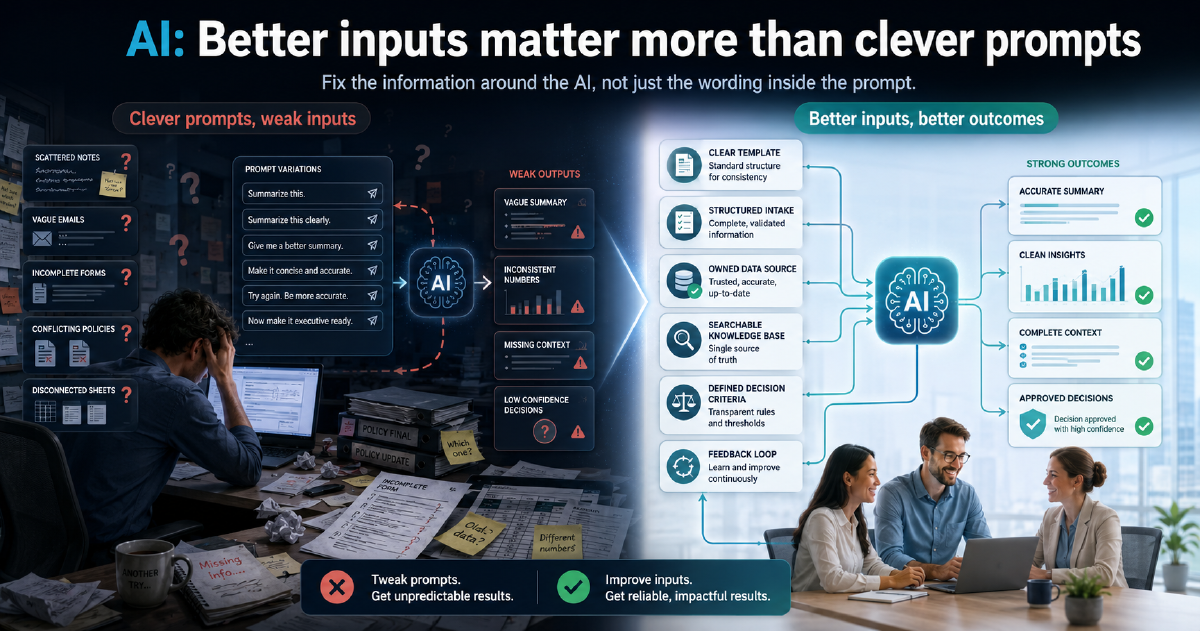
Most AI initiatives underperform for one reason: the AI is stuck compensating for information that’s incomplete, inconsistent or impossible to find.
No prompt, however clever, fixes missing customer details, contradictory policies or knowledge scattered across dozens of disconnected systems. The biggest gains usually come from fixing what goes into the process, not the AI itself.
Better templates #
A consulting firm asks AI to draft client proposals from notes account managers write up. Some notes cover the client’s objectives, budget and deadlines. Others are three sentences copied from an email.
The proposals come out wildly uneven.
Instead of endlessly tweaking the prompt, the company introduces a standard opportunity brief that captures:
- The client’s problem
- Desired business outcome
- Scope and exclusions
- Budget range
- Decision-makers
- Target delivery date
- Evidence from previous conversations
Now every proposal starts from the information it actually needs, and the AI’s output gets much stronger.
The improvement comes from a better brief, not a cleverer prompt.
Clearer data ownership #
A manufacturer uses AI to answer questions about stock availability. But the numbers don’t agree - the warehouse system, the sales spreadsheets and the ecommerce platform all say something different.
The AI cannot know which number is correct.
The company gives the operations team ownership of inventory data, makes the warehouse system the single source of truth, and sets up a process for resolving discrepancies.
Only then can the AI give a reliable answer.
AI cannot resolve organisational ambiguity that the business itself has never resolved.
Structured inputs #
An insurer uses AI to check whether claims have the information needed for review. Customers describe incidents in an open text box, and routinely leave out dates, locations, item values or supporting evidence.
The company redesigns the claim form to capture:
- Type of incident
- Date and location
- Items affected
- Estimated value
- Police or reference numbers
- Supporting documents
- Relevant circumstances
Now the AI can spot straightforward claims, missing evidence and unusual cases far more reliably.
Structured information reduces the amount the AI has to infer.
Updated policies #
A customer service team uses AI to draft refund decisions. The internal refund policy hasn’t been touched in three years and contradicts itself on delivery delays, damaged products and subscription cancellations.
Employees paper over the gaps with experience. The AI just applies the written rules literally, and its recommendations come out inconsistent.
So the company updates the policy first: it removes the contradictions, adds real examples, and marks out which situations need a manager’s sign-off.
The AI’s recommendations improve immediately, because now it’s working from a policy that’s actually current.
An AI system trained on unclear rules will apply those rules unclearly.
Accessible internal knowledge #
An engineering firm wants an AI assistant to help field technicians diagnose equipment faults. The knowledge exists - it’s just scattered across PDF manuals, old support tickets, individual laptops and the memories of the engineers who’ve been there longest.
Before building the assistant, the company pulls all of it into one searchable knowledge base. Each entry includes:
- Equipment model
- Symptoms
- Likely causes
- Diagnostic steps
- Safety warnings
- Approved resolution
- Source and review date
Now the AI gives useful, evidence-backed guidance instead of generic troubleshooting advice.
The key investment is making organisational knowledge accessible and trustworthy.
Defined decision criteria #
A recruitment team asks AI to find the strongest applicants for a role. The instruction is just: “find the best candidates.”
The output is vague, because the business never defined what “best” means.
The hiring team agrees explicit criteria:
- Essential qualifications
- Required evidence of delivery
- Relevant leadership experience
- Acceptable skills gaps
- Disqualifying conditions
- Factors that must not influence the decision
The AI is told to show evidence against each criterion instead of spitting out an unexplained overall score.
Clear criteria create more consistent decisions and make recommendations easier to challenge.
Feedback from completed cases #
A finance company uses AI to flag loan applications that need extra review. At first, the system makes recommendations based on historical guidance - but nobody records whether those recommendations were actually right.
The company closes the feedback loop. For every completed application, it records:
- The AI recommendation
- The reviewer’s decision
- The reason for any disagreement
- The final customer outcome
- Whether problems emerged later
Over time, the company finds that applications with variable income get escalated for no good reason. It updates the decision rules and examples accordingly.
The system gets better because it’s learning from real outcomes, not just the assumptions it started with.
Every completed case becomes evidence for improving the next one.
The practical lesson is simple:
Do not ask how to write a better prompt until you have asked whether the AI has the right information, in the right format, from a trusted source.