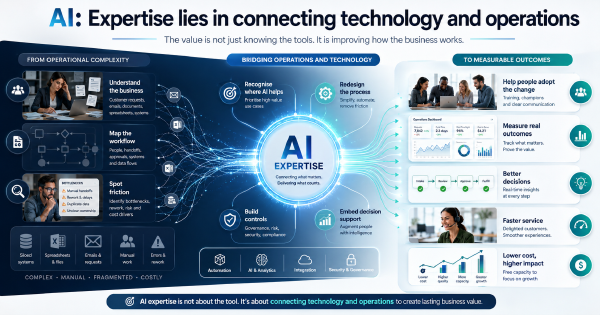
Just reviewing how AI could help a business often surfaces problems that were already there:
- Repeated manual handovers
- Duplicate data entry
- Unclear ownership
- Excessive approvals
- Knowledge trapped in individuals
- Inconsistent decisions
- Work organised around old technology constraints
Automating a process often cleans up ways of working that were already outdated or decaying - before AI adds any value of its own.
What this looks like in customer service #
A mid-sized company brings in an AI assistant to help its customer service team answer policy questions faster.
The expectation is faster email drafting. But once it’s wired into the service workflow, the AI exposes a much bigger problem.
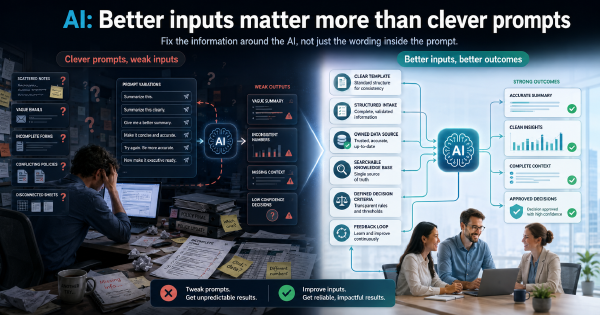
To answer something as simple as “Am I covered for a replacement windscreen?”, an employee has to check the customer’s policy in one system, review product rules in a shared drive, search old emails for exceptions, and sometimes ask underwriting to confirm. Different teams often read the same policy wording differently.
The AI quickly shows that agents spend more time finding and verifying information than actually talking to customers. The same questions get escalated over and over. Response times vary wildly between teams. And a lot of approvals get requested for one reason: employees don’t trust the information in front of them.
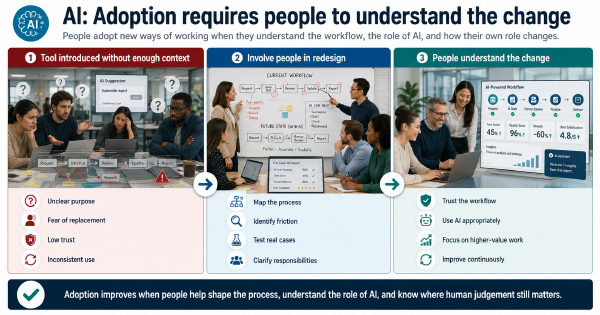
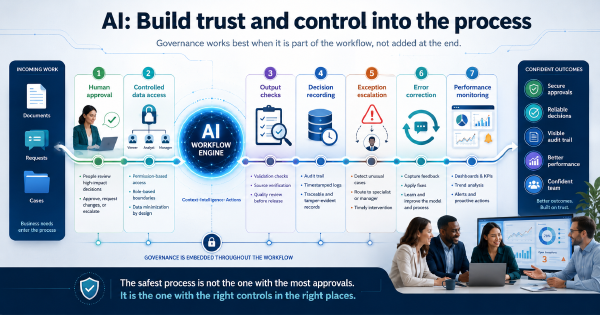
So the company redesigns the process around the AI. It standardises the policy rules and moves them into a single, trusted knowledge base. Now the AI can pull the customer’s policy details, find the relevant rules and give an answer backed by evidence. Straightforward enquiries get handled automatically. Unusual cases, conflicting information and high-value claims go to a specialist.
Instead of just helping employees work a little faster inside a broken process, the AI shows why the process is slow - and helps strip out the unnecessary searching, interpreting and escalating.
The original tool might have saved two minutes writing each email. The redesigned process removes fifteen minutes of investigation and several days of unnecessary handoffs.
AI first exposes the friction, then helps redesign the workflow so less work is needed in the first place.