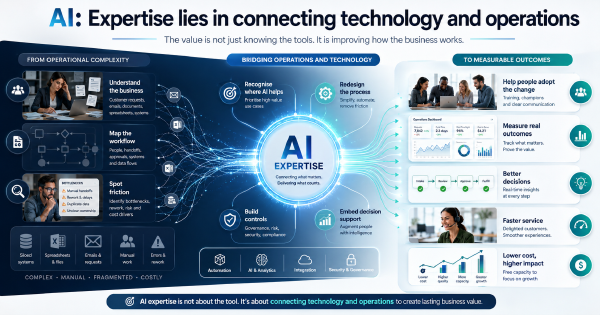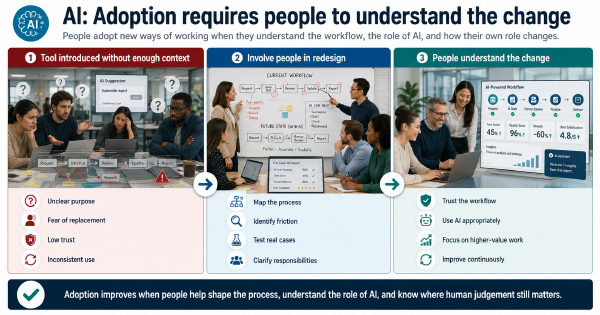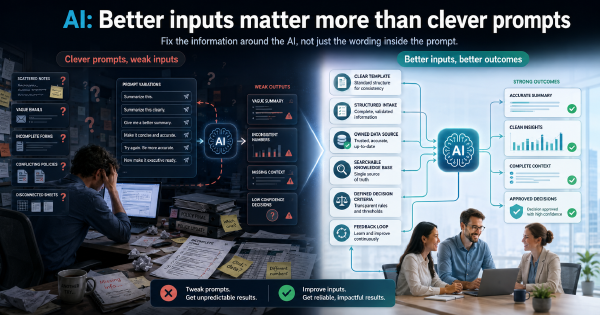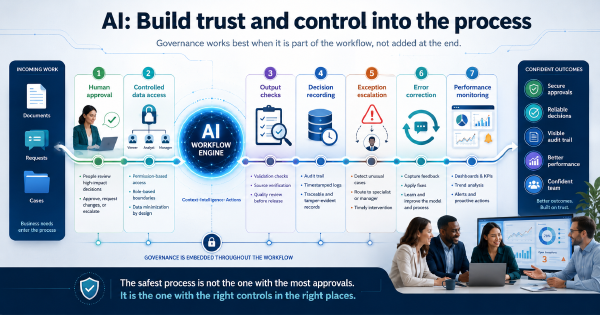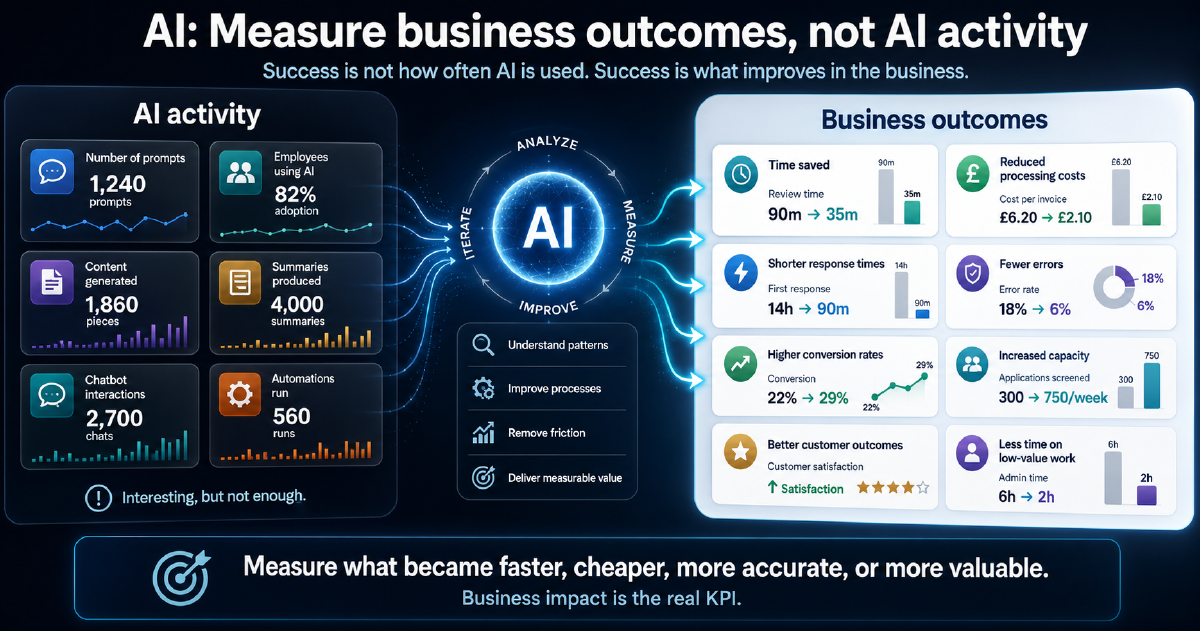
The fact that 80% of employees have tried an AI tool tells you very little about whether the business has improved. Likewise, producing 10,000 AI-generated summaries is not valuable unless those summaries reduce effort, improve decisions or create better customer outcomes.
Measure the change in the work itself.
Time saved #
A legal team introduces AI to review standard supplier contracts. Before implementation, each contract takes an average of 90 minutes to review. Afterwards, AI identifies relevant clauses and potential exceptions, reducing the average review time to 35 minutes.
The meaningful result is not “500 contracts analysed by AI.” It is 458 hours of legal time released each quarter.
Reduced processing costs #
An accounts payable team uses AI to extract information from invoices and match them against purchase orders. The cost of processing an invoice falls from £6.20 to £2.10 because fewer invoices require manual entry.
At 100,000 invoices per year, this represents an annual processing-cost reduction of £410,000.
Shorter response times #
A customer support team uses AI to classify incoming requests, retrieve relevant account information and prepare a draft response. The average first-response time falls from 14 hours to 90 minutes.
The useful measure is not the number of AI-generated replies. It is the percentage of customers receiving a useful response within the company’s service target.
Fewer errors #
An insurance company uses AI to check applications for missing information and inconsistencies before they reach an underwriter. Previously, 18% of applications had to be returned for correction. After changing the workflow, this falls to 6%.
That means fewer delays, less repeated work and 12 fewer problematic applications for every 100 submitted.
Higher conversion rates #
A software company uses AI to analyse sales enquiries and provide representatives with relevant industry examples, likely objections and recommended next actions. The percentage of qualified prospects booking a demonstration rises from 22% to 29%.
The outcome is not “salespeople used AI 2,000 times.” It is seven additional demonstrations for every 100 qualified prospects.
Increased capacity #
A recruitment team previously screened 300 applications per week. AI now organises applications against agreed criteria and highlights the evidence supporting each recommendation. With recruiters still making the final decision, the team can assess 750 applications per week without adding staff.
The gain is 150% more capacity, not simply faster document processing.
Better customer outcomes #
A utility provider uses AI to identify customers whose payment patterns suggest they may be experiencing financial difficulty. Instead of automatically sending escalating payment demands, the workflow routes these customers to a specialist support team.
Success is measured through fewer customers falling into serious arrears, more affordable repayment plans agreed and improved customer satisfaction—not the number of customers flagged by the model.
Less time spent on low-value work #
Project managers previously spent six hours each week collecting updates, formatting reports and chasing missing information. AI now assembles a first draft from project systems and identifies gaps that require attention. Managers spend two hours reviewing the report and four additional hours resolving risks with their teams.
The important outcome is not four hours of administrative time eliminated. It is four hours redirected towards decisions, coaching and problem-solving.
The strongest AI measures therefore connect directly to operational or commercial performance:
What became faster, cheaper, more accurate or more valuable—and what did employees or customers experience as a result?