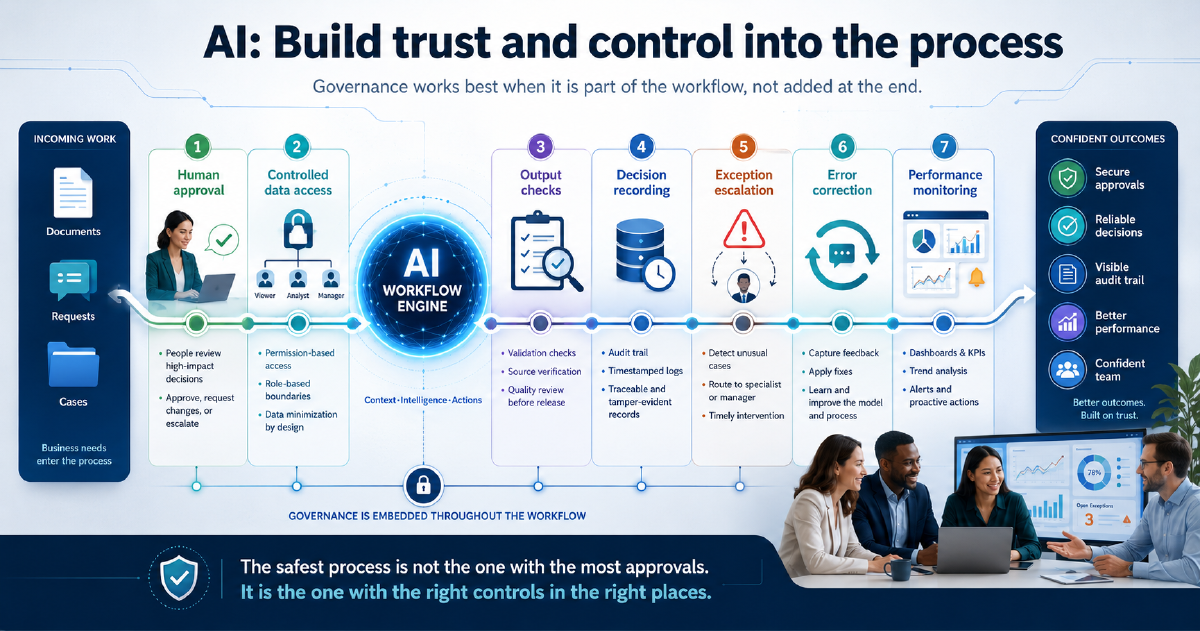
Governance should live inside the workflow, not get bolted on as an obstacle at the end.
The aim isn’t to wrap every AI action in approvals. It’s to find where mistakes would actually cause harm, put controls there, and let low-risk work move fast.
Where human approval is required #
A bank uses AI to review mortgage applications and flag missing information, affordability concerns and potential fraud indicators.
The AI can automatically request a missing payslip or bank statement. But it can’t decline an application, change the interest rate or make the final lending call - those need sign-off from a qualified underwriter.
Straightforward admin gets automated. Decisions with real financial or personal consequences stay with a person.
Human approval is required because of the impact of the decision, not simply because AI was involved.
What data AI may access #
A customer service assistant helps employees answer questions about orders and deliveries.
It can access:
- Order status
- Delivery tracking
- Product information
- Previous support conversations
It cannot access:
- Full payment card details
- Employee HR records
- Unrelated customer accounts
- Internal legal investigations
When a customer asks about a payment dispute, the assistant pulls only the limited transaction information that case needs. Access follows the employee’s role, and every lookup gets logged.
The AI receives the minimum information required to perform the task, rather than unrestricted access to every company system.
How outputs are checked #
A pharmaceutical company uses AI to draft summaries of clinical safety reports.
Before a summary goes anywhere, the workflow automatically checks that:
- Every figure in the summary appears in the source report
- Patient identifiers have been removed
- Required safety sections are present
- The AI has not introduced unsupported conclusions
- A medical reviewer has approved the final wording
The reviewer sees each statement next to the source evidence behind it, which makes verification faster and more reliable.
The output is checked against evidence, not accepted merely because it sounds credible.
How decisions are recorded #
An insurer uses AI to recommend whether claims should be paid, rejected or referred for further review.
For every claim, the system records:
- The information available at the time
- The rules and policy version applied
- The AI recommendation
- The evidence supporting that recommendation
- The confidence level
- The employee’s final decision
- The reason for any disagreement with the AI
If a customer challenges the outcome six months later, the insurer can reconstruct exactly how the decision was reached.
A good record explains not only what happened, but why it happened.
How exceptions are escalated #
A logistics company uses AI to approve routine refunds for late deliveries.
Refunds under £50 go out automatically once tracking data confirms the delay. Cases get escalated when:
- The refund exceeds £50
- The customer has made several recent claims
- Tracking information is contradictory
- The package contains a restricted or high-value item
- The AI’s confidence is low
High-value or suspicious cases go to a specialist team, evidence already assembled.
The normal process remains fast, while unusual cases receive greater scrutiny.
How errors are corrected #
A retailer discovers that its AI assistant has incorrectly told several customers that personalised products can be returned for a full refund.
The company doesn’t just fix the latest response. It:
- Stops the assistant answering questions about personalised returns.
- Identifies all affected conversations.
- Contacts customers who received incorrect information.
- Corrects the underlying policy document.
- Tests the assistant against similar questions.
- Records the incident and the action taken.
- Restores automated answers only once the fix is verified.
The correction process addresses the customer impact, the individual error and the underlying cause.
How performance is monitored #
A finance team uses AI to identify duplicate supplier invoices.
Rather than measuring only how many invoices the AI reviews, the team tracks:
- Genuine duplicates detected
- Valid invoices incorrectly blocked
- Duplicates missed
- Time taken to resolve flagged cases
- Financial losses prevented
- Differences in performance across suppliers and invoice types
The team notices invoices with handwritten purchase-order numbers generate three times as many false alerts. So it adds an extra extraction check for those invoices before duplicate detection runs.
Monitoring is used to improve the process, not merely to prove that the AI is active.
The safest process isn’t the one with the most approvals. Pile on too many, and employees start rubber-stamping work instead of actually checking it.
A stronger approach: automate low-risk, reversible actions. Require human judgement for high-impact decisions. Restrict access to sensitive information. And make important actions visible, traceable and correctable.
Trust comes from knowing where the AI can act, where it must stop and what happens when something goes wrong.
For a real example of this in practice, see how we built exactly this kind of tiered review into health insurance claims processing.