The manual process #
One of the most manual and time-consuming processes at a large Australian health insurer was processing patient claims. Every day, hundreds of claims were submitted by patients who had paid for procedures or other medical services and wanted to be reimbursed. Claims could also come from healthcare providers or through more structured electronic channels, and each route required a slightly different process.
What usually happened was that an employee at the health insurer opened the claim, verified it, and checked the patient’s policy to make sure that it:
- Was still valid on the date of service.
- Covered the submitted claim.
- Had not exceeded the relevant claim limit.
- Met other requirements such as prior authorisation, required documents, provider eligibility, exclusions, and deductibles.
The employee might also have needed to check for duplicate claims, missing information, unusual amounts, or possible fraud before approving, rejecting, or requesting more information.
Add to that the fact that not every submitted claim was a clean, structured PDF. Some were handwritten, while others used an unstructured format. This made it important to understand how many claims arrived in each format and how much processing time each type required.
Why full automation wasn’t the answer #
This meant that a fully deterministic approach was not suitable for every part of the process. Deterministic automation was still useful for clear rules, such as checking whether a policy was active, whether a limit had been exceeded, or whether a claim was a duplicate. OCR helped parse the documents, while AI helped interpret and organise less structured information.
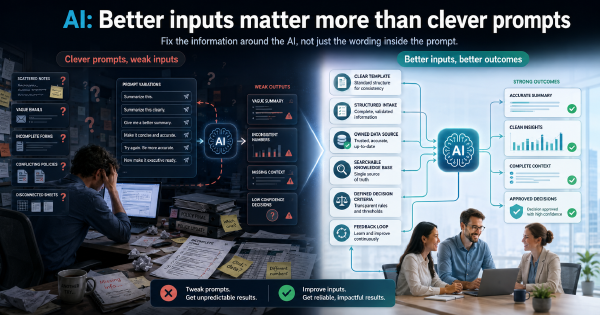
Even then, human review was still needed because what was written was not always clear or straightforward. For example, a vague description could appear to refer to a dental crown procedure, but confirming that might still have required a procedure code, clinical notes, supporting documents, and the exact policy rules. The AI therefore needed to show its interpretation, the evidence it used, and its confidence level instead of silently making assumptions.
What we built #
This was precisely the kind of thing intelligent automation, including AI automation, helped solve. We built an automation that ingested claims from multiple approved sources, such as emails and portal uploads, then classified the documents, extracted the relevant information, ran the deterministic policy checks, and recommended the next action.
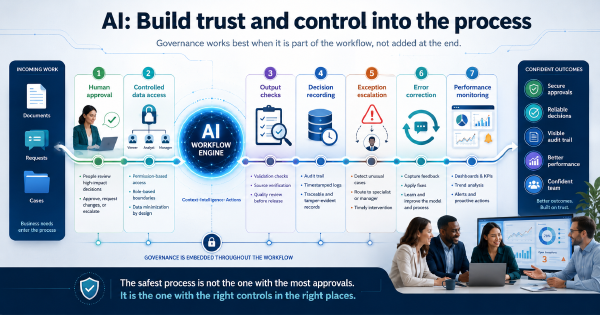
Rather than automatically deciding every claim, the system routed each case into one of three paths:
- Straight-through approval: only for low-risk, high-confidence claims that passed all predefined checks.
- Human review: for unclear, incomplete, high-value, unusual, or low-confidence claims.
- Request for more information: when important documents or details were missing.
Automatic rejections were not included in the initial scope. A false rejection could have led to appeals, regulatory issues, reputational damage, and a poor patient experience. Rejections continued to be reviewed by a qualified employee while the system was tested and validated.
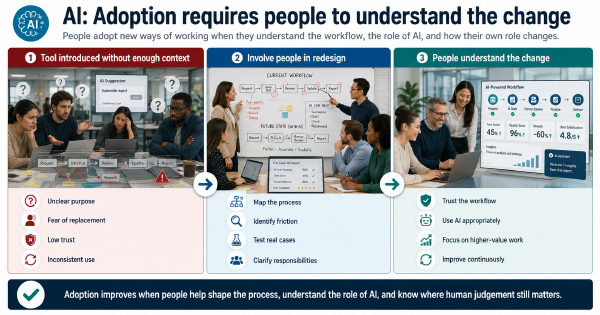
This approach reduced the workload involved in collecting claims from multiple input sources and manually parsing each one, making the employee’s job more focused on verification and exception handling. It did not remove the need for people; it directed their time towards the cases that genuinely required judgement.
Safeguards #
High-value and unusual claims were routed for review, a sample of automatically approved claims could be audited, employees could override a recommendation, and every decision had an audit trail. The system also needed to be monitored for incorrect decisions, fraud attempts, unfair outcomes, security risks, and changes to policy or regulation.
To see whether this automation was effective, we looked at the numbers.
Before automation #
The operating scenario used 500 claims per day and 250 working days per year:
- Employees navigated through emails, downloaded claims, and tracked them in an Excel sheet → 12.5 hours per day, or roughly 1.5 minutes per claim
- Employees parsed and validated the submitted documents → 41.7 hours per day, or roughly 5 minutes per claim
- Employees looked up the patient’s policy and checked it against the claim → 33.3 hours per day, or roughly 4 minutes per claim
- Employees approved, rejected, or requested more information through the portal → 25 hours per day, or roughly 3 minutes per claim
- Total manual time per day → 112.5 hours, or roughly 13.5 minutes per claim
After automation #
Around 25% of claims, or 125 claims per day, still required human review. At an average of 8 minutes per reviewed claim, this required 16.7 hours per day. Employees also audited 5% of the 375 automatically processed claims, with each audit taking around 4 minutes, adding another 1.3 hours per day.
- The automation collected, classified, and extracted the claims → automated
- Deterministic rules performed the straightforward policy and validation checks → automated
- Employees reviewed exceptions and audited a sample of automatically processed claims → 18 hours per day
- Total human time per day → 18 hours
Time and FTE savings #
Daily hours released = 112.5 − 18 = 94.5 hours
Annual hours released = 94.5 × 250 working days = 23,625 hours
Assuming one full-time employee provided around 1,650 productive hours per year:
FTE capacity released = 23,625 ÷ 1,650 = 14.3 FTEs
Using an estimated fully loaded Australian employee cost of A$55 per hour:
Annual gross labour value = 23,625 × A$55 = A$1,299,375
For the business case, the estimated annual costs were A$500,000 for technology, integration, monitoring, compliance, and support, plus A$75,000 for automation-related errors and rework. Avoided manual rework and payment leakage were estimated at A$150,000.
Estimated annual net benefit = A$1,299,375 + A$150,000 − A$500,000 − A$75,000 = A$874,375
These figures represented the operating assumptions used for the business case. They were intended to show the scale of the opportunity and would still need to be validated against measured production data.
The 14.3 FTE figure represented capacity released, not necessarily direct job reductions or cash savings. The financial value would have been realised through avoided hiring, lower overtime or contractor costs, or redeploying employees to other measurable work.
Validating the results #
Before the system was rolled out more widely, it was tested on historical claims and run alongside the existing process. Its decisions were compared with those of trained reviewers, using measures such as extraction accuracy, false approvals, false rejections, handling time, escalation rate, appeals, complaints, and performance across different claim and document types.
The takeaway #
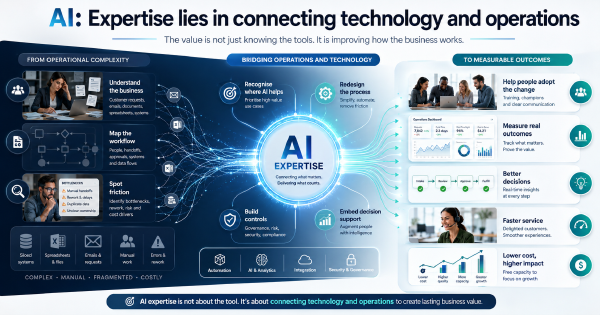
Not only did this reduce the time employees spent on repetitive work, but it also allowed them to focus on what genuinely required their skills, such as ambiguous cases, clinical or coding questions, fraud concerns, and complex policy decisions. The strongest case for the automation was not that AI replaced the entire claims process, but that it handled the repetitive work, applied clear rules, gathered the evidence, and sent the right cases to the right people.