IKEA used AI to automate routine customer service, then moved the staff it freed up into a new role - and that role now brings in over a billion euros a year.
That’s a useful counterpoint to the usual AI story, where automation just means fewer jobs. IKEA’s version reshaped roles instead of cutting them.
AI takes the routine questions first #
IKEA built an AI assistant called Billy to handle first-line customer interactions - order tracking, product questions, general support.
Billy now handles around 57% of customer conversations without a person involved, according to one estimate from Info-Tech Research Group. That’s a big share of the support team’s workload gone.
Nothing unusual there. Plenty of companies are pointing AI at high-volume, repetitive support work.
The questions left over turned out to be about design, not orders #
What IKEA did next is the interesting part. Instead of treating the remaining 43% of conversations as a cost problem, it looked at what those conversations actually were.
Most weren’t transactional. Customers weren’t asking “where’s my order” - they were asking for help planning a room, or a whole space.
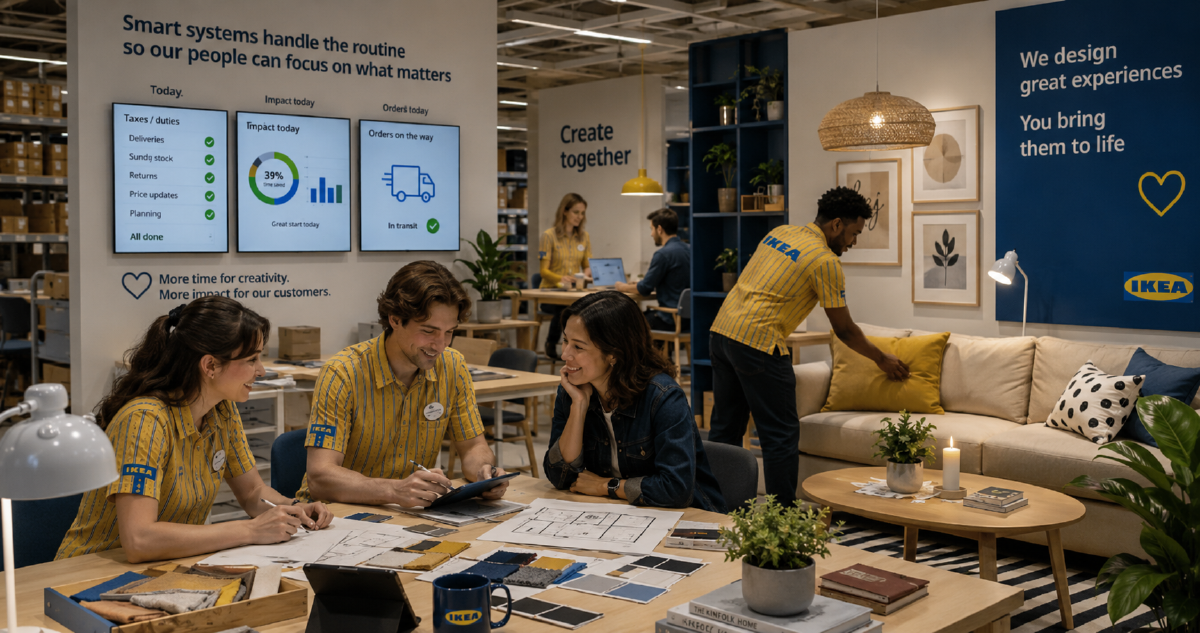
So instead of shrinking the team further, IKEA retrained part of its customer service staff as interior design consultants. The job changed from answering routine queries to giving the advice people were already asking for.
That advice became a paid service #
IKEA turned the insight into a paid design consultancy. In its first year, the offering is estimated to have brought in close to €1 billion in additional revenue.
That’s the real story: the efficiency AI created didn’t just cut cost, it funded a service line the company didn’t have before.
It’s also a useful contrast to Klarna, which replaced hundreds of support agents with AI and then brought people back after service quality suffered. IKEA keeps AI on the high-volume, low-judgement work and gives people the parts that actually need judgement.
Automation can create jobs, not just remove them #
The lesson isn’t “AI is good” or “AI is bad for jobs.” It’s that the outcome depends on what a company does with the capacity AI frees up.
Cut the team and pocket the savings, and AI looks like a threat to jobs. Look hard at what people are actually being asked for once the routine work disappears, and it can fund something the company didn’t have before.
This is the pattern we call redesign the human role - AI doesn’t just remove work, it can free people to do something more valuable.